HRMS vs Payroll Software: What Is the Difference?
- Published date
- Author
- By Tetteh Antonio
HRMS and payroll software are closely connected, but they serve different purposes. This article explains the difference between managing employees and managing salaries, and how a combined HR and payroll platform like Akatua helps growing businesses handle records, payslips, leave, deductions, documents, and reports in one place.
Many businesses use the terms HRMS and payroll software as if they mean the same thing. They are connected, but they do not do exactly the same job.
For growing businesses, understanding the difference can help you choose the right system for managing employees, salaries, payslips, leave, documents, and reports.
What is payroll software?
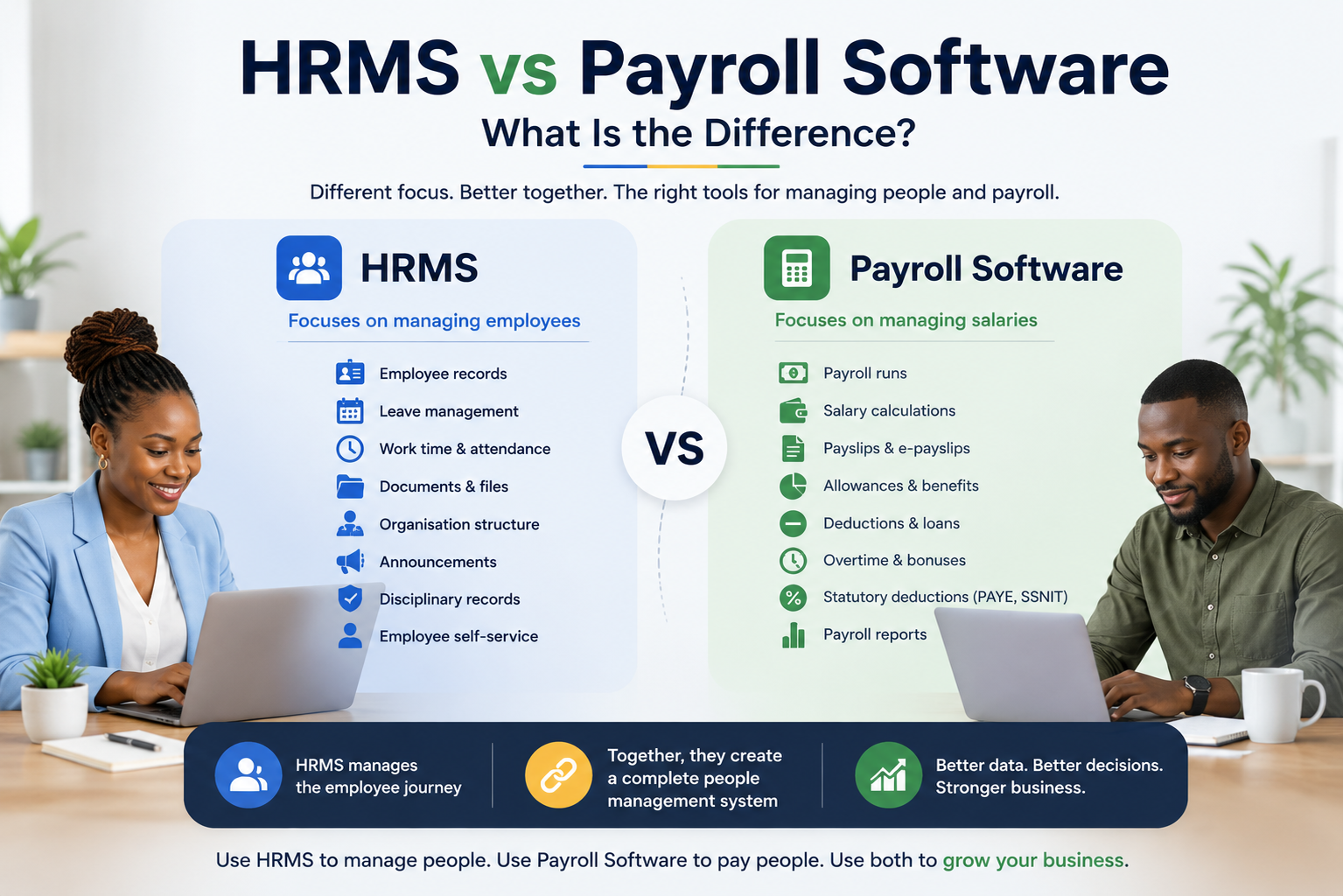
Payroll software helps businesses manage employee salaries and pay-related records.
It is mainly used by finance, HR, or payroll teams to calculate salaries, generate payslips, track deductions, manage allowances, record loans, process bonuses, and prepare payroll reports.
Payroll software usually helps with:
- Monthly payroll runs
- Employee salary records
- Payslips and electronic payslips
- Benefits and allowances
- Overtime and bonuses
- Deductions and loans
- Pay advances
- Payroll reports
In simple terms, payroll software focuses on how employees are paid.
What is an HRMS?
An HRMS, or Human Resource Management System, helps businesses manage the wider employee lifecycle.
It is used to organise employee records, departments, leave, work time, documents, announcements, approvals, disciplinary records, and employee history.
An HRMS usually helps with:
- Employee records
- Organisation structure
- Leave management
- Work time
- Employee documents
- Announcements
- Disciplinary and grievance records
- Employee history
- Employee self-service
In simple terms, an HRMS focuses on how employees are managed.
The main difference
The easiest way to understand the difference is this:
Payroll software manages salary and payment-related processes.
HRMS software manages employee information and HR processes.
Payroll software answers questions like:
“How much should this employee be paid?”
“What deductions apply this month?”
“Has the payslip been generated?”
“What is the net salary?”
An HRMS answers questions like:
“Who works in this department?”
“How much leave does this employee have?”
“Where are their documents stored?”
“What is their employment history?”
Why growing businesses need both
For a small business, payroll and HR may be handled in Excel. But as the company grows, payroll and employee management become harder to control manually.
Salary records, leave requests, payslips, deductions, loans, employee documents, and reports all start to connect. This is why many growing businesses need a platform that combines both HRMS and payroll software.
Akatua is designed as a Ghana-focused HR and payroll platform that centralises employee records, payroll runs, leave management, reports, documents, and company structures across multiple companies and branches.
Is Akatua HRMS or payroll software?
Akatua is both.
It includes payroll management features such as payroll runs, pay advances, benefits, allowances, deductions, loans, overtime, bonuses, and payslips.
It also includes HRMS features such as organisation tree, work time, leave management, announcements, document types, disciplinary records, employee management reports, and employee history.
This makes it useful for businesses that do not want separate systems for HR and payroll.
Conclusion
Payroll software helps businesses manage salaries, payslips, deductions, allowances, and payroll reports.
HRMS software helps businesses manage employee records, leave, documents, organisation structure, work time, and employee history.
For growing businesses, the best option is often a combined HR and payroll platform. This gives HR, finance, and management teams one central system for managing people and payroll together.
Book a demo of Akatua to see how your business can manage HRMS and payroll in one platform.